BY PUNGGAWA CYBERSECURITY MEDIA CENTER
Imagine a senior analyst at a prominent brokerage firm who has to summarize a 100-page confidential financial report before a 9:00 AM board meeting. Pressed for time, they copy and paste the raw, unreleased financial projections into a free, web-based artificial intelligence tool to draft the executive summary.
Within seconds, the summary is ready. But so is a massive, silent security leak.
That sensitive data has just been ingested by a public AI model, where it may be used to train future iterations of the software—accessible to anyone, including direct competitors.
This is the reality of Shadow AI: the unauthorized, unmonitored use of consumer-grade generative AI tools by employees inside corporate networks. While organizations pride themselves on rapid digital transformation and AI innovation, cybersecurity experts warn that this “invisible rat” in our offices is quietly chewing through corporate defenses from the inside.
Shadow AI is the use of artificial intelligence tools, applications, or services by employees without the approval, governance, or oversight of an organization’s IT, cybersecurity, or compliance teams.
What is Shadow AI?
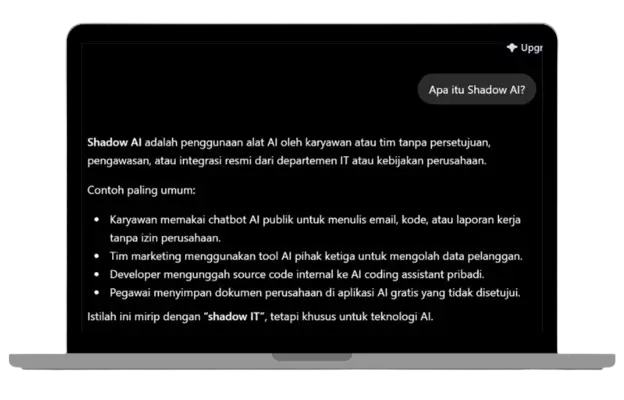
In cybersecurity, “Shadow IT” has long referred to employees using unapproved software, such as personal cloud storage accounts or unauthorized messaging apps, to get work done.
Building on the concept of Shadow IT, Shadow AI refers to the growing use of generative AI tools within organizations outside formal governance and security oversight. While employees often adopt these tools to improve productivity, the lack of visibility creates significant cybersecurity, compliance, and data protection concerns.
According to recent industry surveys, over 70% of employees who use generative AI at work do so using their own personal accounts. The allure is obvious: AI dramatically boosts productivity. However, the corporate blindspot it creates is immense.
Common Examples of Shadow AI in the Workplace
Shadow AI often appears in everyday business activities without employees realizing the associated security risks. Common examples include:
- Uploading confidential reports to public AI chatbots for summarization.
- Using personal AI accounts for work-related tasks.
- Leveraging AI coding assistants to review proprietary source code.
- Installing AI-powered browser extensions without IT approval.
- Using AI-powered design tools to process internal business information.
- Uploading customer or employee data into public AI platforms for analysis.
While these activities may improve productivity, they can also expose sensitive information outside the organization’s security controls.

3 Major Risks of Shadow AI to Businesses
For business leaders and security chiefs, turning a blind eye to this invisible threat carries severe, far-reaching consequences.
1. Corporate Data Leaks and Intellectual Property Loss
The primary danger of Shadow AI is data exfiltration. Public AI models typically retain user prompts to improve and refine their services. When employees paste confidential client information, in-house source code, strategic roadmaps, financial projections, or proprietary business data into these platforms, that information effectively leaves the organization’s secure environment.
Once sensitive data has been processed by an external AI platform, it may be impossible to fully retrieve or remove. This creates significant risks related to data privacy, intellectual property protection, and enterprise cybersecurity.
For organizations whose competitive advantage depends on proprietary information, the consequences of a data leak can be substantial and long-lasting.
2. Violating Global Data Privacy and Compliance Regulations
Under major data protection laws such as GDPR, CCPA, and other privacy regulations, organizations are legally obligated to protect personal and sensitive information from unauthorized disclosure.
If an HR employee uses an unapproved AI tool to analyze employee resumes, payroll structures, or personal information, the organization could face regulatory scrutiny, legal consequences, and significant financial penalties.
As governments and regulators continue to develop AI-related guidance and privacy requirements, organizations must ensure that AI adoption aligns with their compliance obligations. Shadow AI introduces uncertainty and reduces visibility into how sensitive data is being processed.
3. Expansion of the Cyber Attack Surface
Unsecured AI browser extensions, third-party integrations, and unauthorized desktop applications can bypass traditional security controls and create new entry points for cybercriminals.
If an employee downloads a compromised AI-powered tool, attackers may use that connection to gain unauthorized access to corporate systems. These tools can introduce vulnerabilities that security teams may not be aware of, increasing the organization’s attack surface and making cyber risk more difficult to manage.
As AI-powered applications continue to proliferate, organizations must carefully evaluate which tools are permitted within the workplace.
How to Prevent and Combat Shadow AI in the Workplace
Banning AI outright is no longer a viable option. It stifles productivity and often drives employees to use these tools without oversight. Instead, organizations should focus on enabling secure and responsible AI adoption.
-
Deploy Secure, Private AI Sandboxes:
The most effective way to reduce the use of unauthorized AI tools is to provide employees with secure alternatives.
Organizations should consider enterprise-grade AI solutions that offer stronger security controls, administrative oversight, and data privacy protections. Secure AI environments help ensure that corporate information is not used to train public models and remains under organizational control.
-
Expansion of the Cyber Attack Surface:
Organizations must create clear guidelines defining what information can and cannot be shared with AI systems.
Data should be classified according to sensitivity levels, and employees should understand when the use of public AI platforms is prohibited. Effective policies reduce ambiguity and help employees make informed decisions when using AI tools.
Organizations should also ensure that employees have access to approved enterprise AI solutions. Providing secure alternatives often proves more effective than attempting to prohibit AI usage altogether.
Implement Monitoring and Security Controls:
IT and cybersecurity teams should maintain visibility into the applications and services being used across the organization.
Monitoring network traffic, reviewing third-party software usage, and implementing appropriate security controls can help identify unauthorized AI platforms before they become a source of risk.
Continuous Employee Education:
Technology is only as secure as the people using it.
Regular awareness programs should educate employees on the risks of data leakage through AI tools, proper handling of sensitive information, and the organization’s expectations regarding AI usage.
When employees understand both the benefits and risks of AI, they are more likely to use these technologies responsibly.
Implementing these robust measures—from deploying advanced monitoring controls to auditing unauthorized AI applications—requires specialized expertise. As a trusted security partner, Punggawa Cybersecurity helps organizations safely navigate generative AI adoption by establishing comprehensive visibility, risk assessment, and data protection strategies tailored to your infrastructure. Safeguard your company’s sensitive data and effectively mitigate Shadow AI risks by exploring our specialized security solutions at Punggawa Cybersecurity Services.
Why AI Governance Matters
As organizations accelerate their adoption of generative AI technologies, cybersecurity teams must ensure that innovation is supported by appropriate governance, risk management, and security controls.
Effective AI governance helps organizations balance productivity gains with data protection, regulatory compliance, and cybersecurity requirements. By establishing clear guardrails and approved AI solutions, businesses can embrace innovation without introducing unnecessary risk.
Organizations that treat AI governance as a business priority will be better positioned to realize the benefits of artificial intelligence while maintaining trust, security, and operational resilience.
The Way Forward: Balanced Innovation
As industries worldwide accelerate their adoption of advanced AI technologies, the goal should be to build a trusted and resilient enterprise ecosystem.
To achieve this, organizations must recognize that cybersecurity and AI adoption are not opposing objectives. Innovation and security must work together.
Leading cybersecurity experts continue to encourage organizations to audit their digital ecosystems, monitor shadow systems, and establish governance frameworks that support responsible AI adoption.
By implementing clear policies, providing secure AI tools, and maintaining strong oversight, businesses can harness the transformative power of artificial intelligence without sacrificing security, compliance, or corporate integrity.
Frequently Asked Questions (FAQ)
What is Shadow AI?
Shadow AI refers to the use of artificial intelligence tools without approval, governance, or oversight from an organization’s IT, cybersecurity, or compliance teams.
Why is Shadow AI considered a cybersecurity risk?
Shadow AI can expose sensitive data, increase the attack surface, create compliance challenges, and reduce visibility into how information is being processed and shared.
Is ChatGPT considered Shadow AI?
ChatGPT itself is not Shadow AI. However, using a public AI platform for work-related activities without organizational approval or governance may be considered Shadow AI.
How can organizations reduce Shadow AI risks?
Organizations can reduce Shadow AI risks by implementing AI governance policies, providing approved AI solutions, conducting employee awareness training, and maintaining visibility into AI usage across the organization.
What industries are most vulnerable to Shadow AI?
Industries that process large volumes of sensitive information—including financial services, healthcare, government, legal services, and technology companies—often face elevated Shadow AI risks.
What industries are most vulnerable to Shadow AI?
Punggawa Cybersecurity provides comprehensive visibility and control over unauthorized AI usage within your infrastructure. Through tailored risk assessments, advanced monitoring solutions, and data protection strategies, Punggawa helps your organization safely audit, manage, and secure generative AI adoption without sacrificing employee productivity.
Conclusion
Innovation is essential for maintaining competitiveness in today’s digital economy, but it should never come at the expense of security.
Shadow AI has emerged as one of the most significant cybersecurity challenges facing modern organizations. While generative AI delivers substantial productivity benefits, unmanaged usage can expose businesses to data leakage, compliance violations, intellectual property loss, and increased cyber risk.
Organizations that proactively address Shadow AI today will be better positioned to adopt emerging AI technologies securely tomorrow. Regular cybersecurity assessments, employee awareness programs, and strong AI governance practices are essential for building a resilient and AI-enabled organization.
By taking a balanced approach to innovation and security, businesses can unlock the full potential of artificial intelligence while protecting the assets, data, and trust that matter most.