
BY PUNGGAWA CYBERSECURITY MEDIA CENTER
In today’s high-stakes enterprise environment, defending your organization against sophisticated threat actors requires more than just installing firewalls and antivirus software. Security operations teams need structured frameworks to map, understand, and neutralize adversaries at every stage of an intrusion.
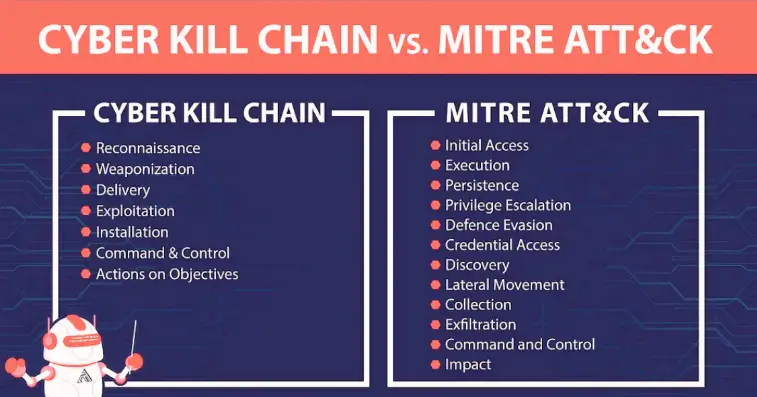
Among the various security models available today, two frameworks stand out as global industry standards: Lockheed Martin’s Cyber Kill Chain and the MITRE ATT&CK matrix. While both models aim to identify, track, and stop cyber adversaries, they approach the challenge from fundamentally different perspectives.
Understanding the operational nuances of MITRE ATT&CK vs. Cyber Kill Chain is essential for CISOs, IT directors, and security leaders seeking to build a resilient threat detection and incident response strategy.
Deconstructing the Cyber Kill Chain: Strategic Linearity
Developed by defense contractor Lockheed Martin in 2011, the Cyber Kill Chain is a foundational model derived from military doctrine. It conceptualizes a cyberattack as a sequential, multi-stage pipeline. The core premise is simple yet powerful: if defenders can disrupt an attacker at any single stage in the chain, the entire intrusion fails.
The Cyber Kill Chain breaks down an intrusion into seven linear phases:
Reconnaissance: The adversary gathers intelligence on the target (e.g., harvesting email addresses, scanning IP blocks, identifying exposed software).
Weaponization: The attacker couples a malicious payload with a deliverable file format (e.g., an infected PDF or Office document).
Delivery: The weaponized payload is transmitted to the victim’s environment, typically via spear-phishing emails or compromised websites.
Exploitation: The malicious code triggers, exploiting a software vulnerability or tricking a user into executing the file.
Installation: The malware installs itself on the target endpoint, establishing a foothold within the corporate perimeter.
Command & Control (C2): The installed payload opens a covert communication channel back to the attacker’s external infrastructure, allowing remote administration.
Actions on Objectives: The adversary executes their final goal, such as exfiltrating confidential data, encrypting files for ransom, or destroying system infrastructure.
Because of its high-level, linear structure, the Cyber Kill Chain serves as an excellent strategic tool for executive briefings and high-level defense architecture planning.
Unpacking MITRE ATT&CK: A Granular Behavioral Matrix
| Feature / Aspect | Cyber Kill Chain | MITRE ATT&CK |
|---|---|---|
| Originating Body | Lockheed Martin (2011) | MITRE Corporation (Ongoing Project) |
| Architectural Model | 7-Stage Linear Sequence | Dynamic Matrix of Tactics & Techniques |
| Primary Focus | High-level atttack progression | Post-compromise adversary behaviors (TTPs) |
| Core Value | Perimeter defense & initial prevention | Threat hunting, SOC detection, Red/Blue alignment |
| Target Audience | C-suite, executives, non-technical stakeholders | Security analysts, threat hunters, SOC engineers |
| Complexity Level | High-level, accessible, simplified | Technical, deeply detailed, comprehensive |
The Scope Gap
The Cyber Kill Chain heavily emphasizes perimeter defense—stopping the attacker before or during payload execution. However, modern attacks often bypass perimeters via stolen credentials or zero-day exploits. This is where MITRE ATT&CK excels: it assumes the perimeter has already been breached and focuses on detecting what the attacker does inside the network.
Strategic Implementation: When to Deploy Each Framework
Rather than treating MITRE ATT&CK vs. Cyber Kill Chain as a strict binary choice, forward-thinking enterprise defense teams leverage both frameworks in a complementary, hybrid architecture.
When to Use the Cyber Kill Chain:
Executive & Board Communication: Explaining security incidents and defensive investments to non-technical leadership requires a clear narrative. The 7-step Kill Chain provides an accessible storytelling framework.
Fundamental Training: Educating junior analysts or staff on basic security hygiene and the lifecycle of cyber threats.
Perimeter Defense Planning: Structuring multi-layered security controls to block initial delivery vectors (e.g., email gateways and web filters).
When to Use MITRE ATT&CK:
Building SIEM and EDR Detection Rules: Writing targeted detection logic for specific attacker techniques, such as credential dumping via LSASS memory reads.
Threat Hunting & Incident Response: Triaging alerts inside a Security Operations Center (SOC) to determine where an adversary is positioned within a network.
Red Team / Blue Team Exercises: Conducting realistic adversary emulation tests to measure defensive visibility against known threat group behaviors (e.g., APT28 or FIN7).
Operationalizing Cyber Frameworks with Punggawa Cybersecurity
Implementing frameworks like MITRE ATT&CK or Cyber Kill Chain requires specialized expertise, continuous monitoring, and actionable intelligence. At Punggawa Cybersecurity, we bridge the gap between theoretical frameworks and real-world defense. Through our comprehensive suite of enterprise services—including Managed SOC 24/7, Penetration Testing, Security Architecture, and Incident Response—we help organizations map their digital footprint directly against global TTP benchmarks. Whether you need to strengthen your perimeter against initial Kill Chain vectors or deploy proactive threat hunting mapped to MITRE ATT&CK tactics, Punggawa delivers tailored enablement to keep your enterprise resilient and compliant.